John Magnan Sculpture Studio

about the artist/contact


Transformation

2009

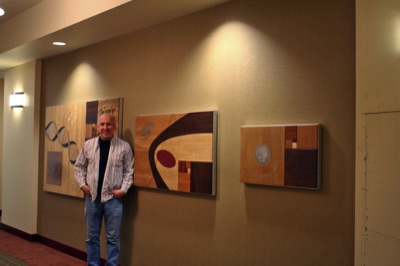
On permanent display at The Tauri Group, Alexandria, Virginia


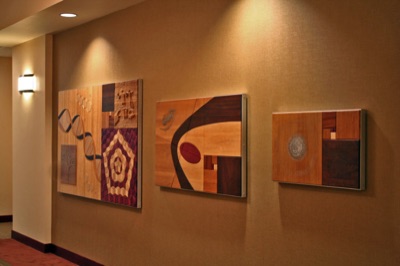
The triptych Transformation suggests three stages in the development of life.

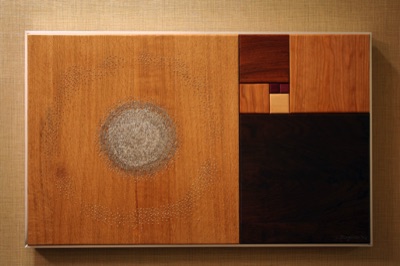
On the smallest panel, T Tauri, a pin design depicts early solar system formation. Gravitation aggregates dust and gas orbiting the coalescing central body. Eventually, planets will form and the infant star will grow massive enough to trigger fusion.

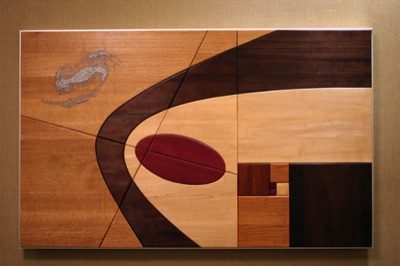
NGC1300 (New General Catalog 1300), a magnificent spiral galaxy not unlike our own Milky Way, is rendered in pins on the center panel. Sweeping conic sections in the foreground suggest the elliptical, parabolic and hyperbolic trajectories followed by celestial bodies as they swoop around the now mature sun.

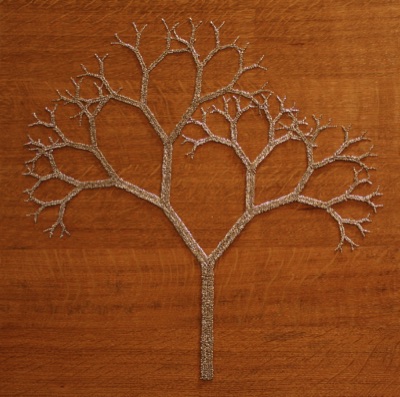
Life eventually emerges on the large panel, Signs of Life. DNA has formed, and evidence of intelligent life can be found in the use of Penrose tiles to form the pentagonal star and the mathematical fractal tree, hammered out in pins.

Transformation reflects the strong professional and highly technical culture of the The Tauri Group. Nothing in Transformation is about Tauri Group per se, but everything in the art can be recognized and appreciated from both aesthetic and technical points of view.

Underlying the symbols in the panels is homage to the mathematician Fibonacci. His famous sequence (0, 1, 1, 2, 3, 5, 8, …, Fn , …), and the golden ratio derived from it, is used throughout. Each panel is golden, meaning the ratio of length to width is 1.62, the converged value of the sequence Fn+1/Fn

Transformation uses Fibonacci-sized squares as vocabulary. Starting with the tiny pair of purple heart squares in each panel, successive squares spiral outward, with the dimension of the next square equal to the sum of the dimensions of the previous two: a Fibonacci sequence. The next larger square in the sequence is added to one panel to create the next, and the assembly of the first seven squares is carried forward and repeated for continuity among all three panels. As a result, the length of the small panel is the width of the medium panel, and the length of the medium panel is the width of the large panel.

24,000 dressmaker pins are used to create the metal designs in the panels. Each pin was clipped by hand and the remaining short piece was tapped in using a predetermined pattern.

Six types of wood are used: white oak, Peruvian walnut, purple heart, Canadian maple, Brazilian cherry and North American cherry.